
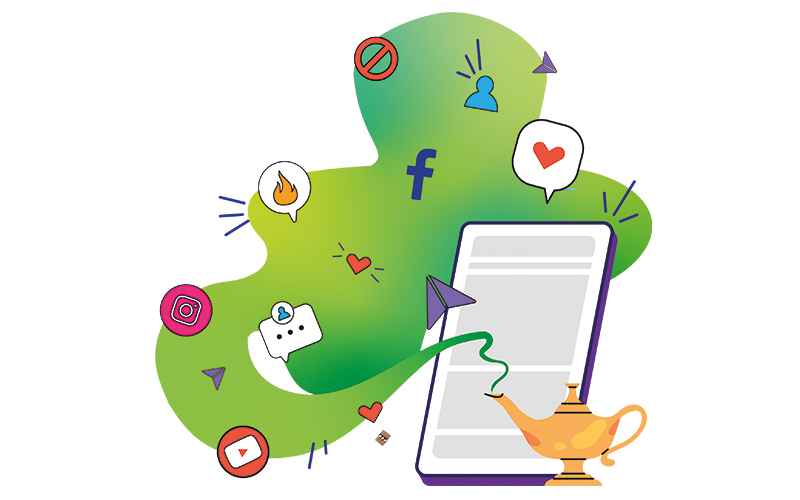
Following the recent banning for under-16s in Australia, other nations, including the UK, are considering their options – but is the genie already out of the bottle? Journalist Jo Waters reports.
A clampdown on social media, banning it for children under a certain age, is one of the options out for consultation by the UK government. This is all very recent and fast-moving, with the consultation announced at the end of January (Department for Science, Innovation and Technology (DSIT) and Department for Education (DfE), 2026), and opened to all at the start of March (DSIT, 2026a). France and Spain are set to follow Australia’s lead this year, with a full ban on social media for under-15s in France (Schofield, 2026; Wertheimer, 2026).
It follows mounting concerns about the influence of Big Tech social media platforms on children’s mental health and general wellbeing, the addictive algorithms they use and the disturbing violent and pornographic content they share.
THE CURRENT PICTURE
The House of Lords voted in January for a ban on social media for children, in an amendment to the Children’s Wellbeing and Schools Bill (UK Parliament, 2026a). Under the amendment, the government would have a year to decide which platforms should be unavailable to under-16s in the UK, and companies would be forced to put more effective age checks in place.
However, the amendment was rejected by MPs in March (UK Parliament, 2026b), with the government preferring instead its own three-month public consultation exercise to consider a range of options.
The government social media consultation is seeking views on a range of measures, including determining the right minimum age for children to access social media and exploring a ban for children under a certain age. Overnight curfews and tougher age checks are other options on the table, as is removing or limiting algorithms that drive addictive or compulsive use of social media, such as ‘infinite scrolling’. This is alongside support for parents to help their children navigate the digital world (DSIT and DfE, 2026). AI chatbots and gaming have also been added into the mix (DSIT, 2026a).
Additionally, the prime minister and technology secretary have announced new legislative powers that would allow the government to act quickly on the consultation’s findings, with new legislation that will come into force within months, rather than years, once passed (DSIT, 2026b).
In February, prime minister Keir Starmer stressed his commitment to protecting children online on his Substack account: ‘I will take the time needed to get this right. I will ensure that the actions we take are the right ones. But once that decision has been made, I will waste no time in getting on with it’ (Starmer, 2026).
THE RIGHT APPROACH?
Andy Burrows is chief executive of Molly Rose Foundation, the suicide prevention charity set up in memory of 14-year-old Molly Russell. Andy says that parents and politicians have been presented with a false choice between a social media ban or tolerating the appalling harm caused bysocial media.
‘There is now a clear consensus that bold and decisive action is needed. Rather than rush to easy and simplistic solutions, we support the government’s plan to work through the full range of options and take the time to get this right,’ he adds. ‘Children and parents will benefit most from quick action to strengthen legislation, rather than the false comfort offered by bans.’
Children’s commissioner for England Dame Rachel de Souza says she supports Australia’s bold approach, but stresses a ban on social media is not an immediate guarantee of children’s safety.
‘If, after consultation, ministers put forward a clear plan to properly enforce a ban that takes account of how they [young people] access sites and see harmful content, I would support it and I will work closely with government to ensure children are at the heart of that consultation.’
But Daisy Greenwell, founder and codirector of the Smartphone Free Childhood campaign, says social media platforms have been getting away with causing everyday harm to children’s lives.
‘There needs to be a complete reset. We shouldn’t have children on platforms designed for adults,’ says Daisy. ‘What families want is a clear boundary.’
She highlights that the current age limit of 13 is not being enforced, with 20% of children aged five using social media platforms unsupervised, according to regulator Ofcom’s figures.
‘We welcome the consultation [however]; it’s important to get this right and ensure the legislation sticks.’
‘RATHER THAN ALL-OR-NOTHING BANS, OUR RESEARCH SUGGESTS THAT MORE TARGETED, FLEXIBLE APPROACHES MAY WORK BETTER’
THE SOCIAL MEDIA IMPACT
Daisy says children are being radicalised by extreme and violent content, including car crashes and beheadings, terrorism and extreme viewpoints amplified by social media algorithms. She says anxiety and depression cases among young people have skyrocketed with smartphone use, but that it’s hard to prove causation for mental health problems.
‘There’s enough evidence now that children are being harmed on a mass scale and they’ve been guinea pigs in a massive experiment,’ she says.
Consultant psychiatrist Dr Priya Nathwani has witnessed the negative impact of excessive social media use on young people.
‘It can affect people’s sleep, especially if they are using it at night-time or evening. It means they can’t relax and switch off,
and it can definitely affect their mood, particularly the comparison aspect, which can affect self-esteem.’
Dr Nathwani says there are concerns about children accessing violent, extreme pornographic material (as noted in the last issue of Community Practitioner), as well as self-harm and anorexia content, and dangerous challenges.
‘As adults, we have the skills to work out what’s healthy or dangerous, but children and young people don’t. Their brains are still developing and they’re very much more vulnerable, and can be drawn into the negative aspects.’
Dr Emma Sullivan conducted research at the University of York, studying the effects of a 21-day smartphone ban on children in a secondary school, as part of a Channel 4 documentary. Her research (in pre-print at time of writing) found health benefits, including improvements in sleep, improved mood, less anxiety and depression symptoms, and better attention spans (Sullivan et al, 2025). However, young people also reported boredom and FOMO (fear of missing out).
‘WE CAN TRY TO MANAGE ITS IMPACT BY ACTIVELY ENCOURAGING AND SUPPORTING PEOPLE TO RECOGNISE THE VALUE OF REAL-LIFE CONVERSATIONS OVER’
FINDINGS SO FAR
Australia’s social media ban for under-16s came into force on 10 December 2025 (Watson and Wilson, 2026) and prohibits access to 10 platforms: Facebook, TikTok, Instagram, Snapchat, Threads, X, YouTube, Reddit and the streaming platforms Kick and Twitch (so not including WhatsApp).
Firms that fail to take reasonable steps to keep under-16s off their platforms face fines of up to £24.5m each. The restrictions have been criticised for leaving out dating and gaming apps, and there are already reports of young people circumventing the ban
by downloading VPN addresses or managing to cheat age-verification checks. The Australian e-Safety Commissioner reported
4.7 million accounts had been deleted by late January 2026 (Taylor, 2026).
Zali Steggall, an independent MP in Australia’s Federal Parliament, says the UK should resist the temptation to treat the age ban as a panacea, adding that protecting children online requires a suite of measures. Writing for the UK online site Politics Home (Steggall, 2026), she said: ‘The overall aim should not be restricting social media access, but building resilience and safety for a generation
growing up in a complex, high-pressure digital world.’
WHAT’S THE ANSWER?
Dr Claire Bullen-Foster, clinical psychologist, says phone bans in schools, with the use of locked magnetic pouches during school
hours, have seen positive results.
‘There is evidence coming through that classroom behaviour is improving, and there’s been a reduction in absenteeism and improvements in engagement and attainment.’
Dr Bullen-Foster, who is also CEO of Eleos Group, a company that works with children and schools to deliver mental health support, says: ‘I’m more drawn to how we can better protect children who use social media and how we can better regulate what they are exposed to, rather than a blanket ban for certain age groups.’
Dr Sullivan says: ‘Rather than all-ornothing bans, our research suggests that more targeted, flexible approaches may work better, such as bedtime restriction (for example, no phones one hour before bed), rather than total bans.
‘These focused interventions appear more likely to maintain benefits over time. ‘Interestingly, 83% of students support government action to address smartphone and social media use in young people. This shows that young people themselves recognise there’s a problem and want help addressing it.’
HOW CPs CAN HELP
CPHVA president and former health visitor Yvonne Coghill says that young people are still growing and developing, and constant attachment to smartphones and social media is not healthy.
‘HVs have an important role in advising parents about the safe use of the internet and social media. When visiting families, we can highlight the value of spending time together, talking, sharing and connecting, without always being on technology. That applies to adults as much as it does to children and young people,’ says Yvonne.
‘School nurses [SNs] also have a key role to play. They can speak to young people about the importance of face-to-face time with friends and family, and about taking part in activities that aren’t centred on phones or social media.’
CPHVA Executive member Rhian Ogden, a lecturer in child health at the University of Leeds School of Healthcare, says HVs and SNs can also share information from research with parents. This should include findings on the effects and risks of smartphone use on children’s sleep, concentration and anxiety levels, so parents and young people can make informed decisions about their social media use alongside a ban.
‘HVs can help educate parents about their child’s responsible screen use and – as their children get older – social media exposure,’ says Rhian. ‘SNs can be talking directly to young people about their phone usage and how to use their phones responsibly.’
‘83% OF STUDENTS SUPPORT GOVERNMENT ACTION TO ADDRESS SMARTPHONE AND SOCIAL MEDIA USE IN YOUNG PEOPLE. THIS
SHOWS THAT YOUNG PEOPLE THEMSELVES RECOGNISE THERE’S A PROBLEM AND WANT HELP ADDRESSING IT’
MORE THAN A BAN?
Rhian believes a ban on its own, without a robust support structure to enforce it, could be counterproductive. ‘We have to be really careful about taking things away as, sometimes, that can push people to do things in a way that’s even less safe, and unregulated – that would be my concern,’ she says.
‘We wouldn’t want to inadvertently push teenagers who circumvent a ban into a more vulnerable position.’
Rhian adds that a multipronged approach is needed early in childhood. ‘We need to educate children at a young age in schools, in a proactive way – teaching them about smartphone and internet use, how to use them safely, and some of the damaging effects of social media – before they start using them.
‘Then we need to support parents on how they can have conversations with children and teens around their social media use. Part of the problem is that it’s very difficult to enforce controls on their child’s social media use as so many have similar addictions to phone
use themselves.’
Yvonne also acknowledges the challenge. ‘The genie is out of the bottle when it comes to social media, and it’s going to be very difficult to put it back in,’ she says. ‘But we can try to manage its impact by actively encouraging and supporting people to recognise the value of real-life conversations over constant phone use.’
Yvonne compares this approach to other areas of preventative health, such as healthy eating and exercise. ‘It’s about enabling
people to make informed, healthy choices for themselves, including about what they consume online.’
The government’s consultation on children’s digital wellbeing, which covers the potential social media ban, will close on 26 May 2026, and is seeking the views of parents, carers, young people, academics, industry and those who work with children (DSIT, 2026a). So CPs can have their say, too.
Despite the recent MP vote against the House of Lords amendment to the Children’s Wellbeing and Schools Bill, there seems to be general consensus in UK society that some sort of controls to protect children online should be introduced, sooner rather than later.
Bridget Phillipson, education secretary, summed up the government’s position at the opening of the consultation (DSIT, 2026a): ‘Every child deserves a childhood – real experiences, real friendships, real opportunities. We are determined to make that a reality, both inside and outside the classroom.’
RESOURCES
- For parents: full guidance, conversation starters and safety advice from the government’s new ‘Kids Online Safety’ campaign website
- ‘What I wish my parents or carers knew’ a guide for parents and carers on managing children’s digital lives, from the Children’s Commissioner for England
- Smartphone Free Childhood
- Resources for health professionals, the EU’s Better Internet for Kids
Image | ISTOCK
REFERENCES
Department for Science, Innovation and Technology. (2026a) Landmark consultation seeks views on major measures to protect children on social media, gaming platforms and AI chatbots. See: gov.uk/government/news/landmark-consultation-seeks-views-on-major-measures-to-protect-children-on-social-media-gaming-platforms-and-ai-chatbots (accessed 5 March 2026).
Department for Science, Innovation and Technology. (2026b) Growing up in the online world: a national conversation. See: gov.uk/government/consultations/growing-up-in-the-online-world-a-national-consultation/growing-up-in-the-online-world-a-national-conversation (accessed 16 March 2026).
Department for Science, Innovation and Technology and Department for Education. (2026) Government to drive action to improve children’s relationship with mobile phones and social media. See: gov.uk/government/news/government-to-drive-action-to-improve-childrens-relationship-with-mobile-phones-and-social-media (accessed 5 March 2026).
Schofield H. (2026) ‘Major step’: French MPs vote in favour of bill to ban social media for under-15s. See: bbc.co.uk/news/articles/c07x003vx0yo (accessed 5 March 2026).
Starmer K. (2026) Giving children the space to grow- an update. See: keirstarmer.substack.com/p/giving-children-the-space-to-grow (accessed 5 March 2026).
Steggall Z. (2026) Politics Home: Learn from Australia – banning social media for under-16s is no panacea. See: politicshome.com/opinion/article/learn-australia-banning-social-media-under16s-no-panacea (accessed 5 March 2026).
Taylor J. (2026) More than 4.7m social media accounts blocked after Australia’s under-16 ban came into force, PM says. See: theguardian.com/australia-news/2026/jan/15/australia-u16-social-media-ban-millions-accounts-blocked (accessed 5 March 2026).
UK Parliament. (2026a) Parliamentary Bills: Children’s Wellbeing and Schools Bill. See: bills.parliament.uk/bills/3909 (accessed 5 March 2026).
UK Parliament. (2026b) Children’s Wellbeing and Schools Bill. See: hansard.parliament.uk/Commons/2026-03-09/debates/655E6B7C-4642-44D5-ABFE-236ADC69819A/details (accessed 17 March 2026).
Watson K, Wilson T. (2026) Social media firms have come to ban ‘kicking and screaming’, says Australia eSafety boss. See: bbc.co.uk/news/articles/c5y33xjmm3mo (accessed 5 March 2026).
Wertheimer T. (2026) Spain announces plans to ban social medica for under-16s. See: bbc.co.uk/news/articles/c5y2nddvmryo (accessed 5 March 2026).