
Around four million children currently live in poverty in the UK. Is a commitment to lift 550,000 out of poverty by 2030 enough? Journalist Jo Waters explores the crisis and asks what needs to be done to truly tackle it.
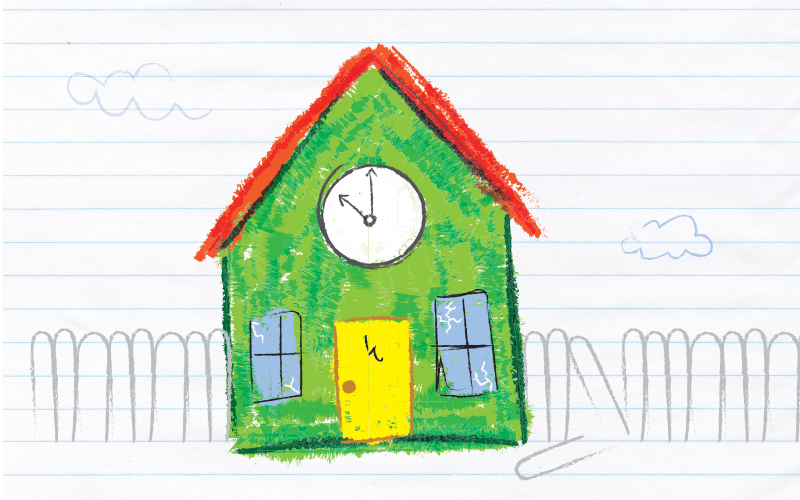
Nearly one in three, or around four million children live in poverty in the UK (Department for Work and Pensions [DWP], 2026) with devastating implications for their health, education and future life chances. Around two million of the total are living in deep
poverty, defined as less than 40% of median household income (Cabinet Office, 2025). More children living in poverty are also in working families, but those families are in jobs with low hourly pay and low hours.
Children continue to be disproportionately affected by poverty and that figure rose for single-parent families (DWP, 2025a). A recent analysis of the DWP 2025 poverty figures by the Joseph Rowntree Foundation (JRF) charity found that around one in 10 of the UK population is living in deep poverty (households with an after housing cost [AHC] income of less than 40% of the UK median). This equates to £16,400 a year or below for a couple with two young children (JRF, 2026).
As shocking as these statistics may sound, they come as no surprise to community practitioners, says CPHVA Executive member and former health visitor Kate Phillips. CPs are dealing with the impact of child poverty on the frontline every day, says Kate.
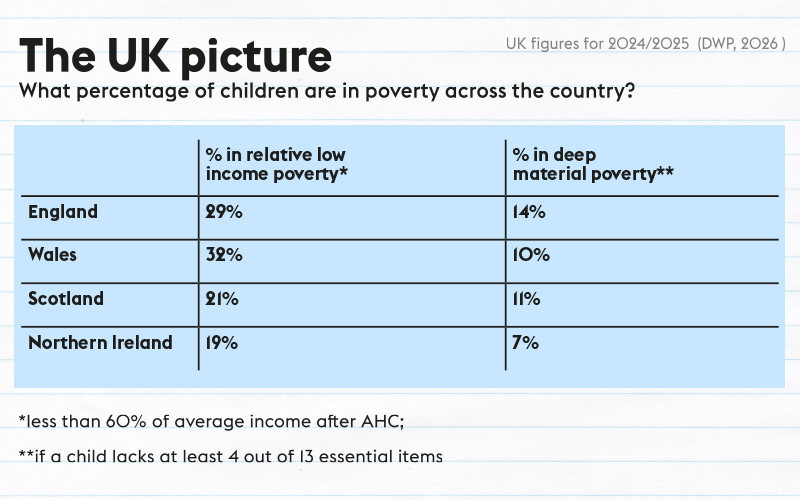
‘Some families are struggling to cope with the rising cost of living, unable to put food on the table in some cases or pay their heating bills – it’s heat or eat for them. Wages are not increasing to keep pace with rising inflation.’ Child poverty rates vary across the four UK nations, but are higher in England and Wales than in Scotland and Northern Ireland (see The UK picture, below).
In December last year, the Labour government published the Child Poverty Strategy (DWP and Department for Education, 2025), stating the ambition of lifting 550,000 children out of poverty by 2030. The cross-government plan focuses on driving down the cost-of-living essentials
and improving local support services. But nine months on from a statement of those bold ambitions – and with a new Prime Minister in Downing Street, what progress has been made, and is enough being done to reduce child poverty?
Serious impact
Poverty affects children before they are even born, says the Child Poverty Action Group charity (CPAG, 2026) as they are more likely to have low birth weight and less likely to survive their first year of life. They are also more likely to suffer from asthma and other childhood diseases, and experience poor health later in life.
‘Children who grow up in persistent poverty are also three times more likely to become NEETS (Not in Education, Employment or Training),’ says Sam Tims, lead analyst on social security and economics with the JRF. ‘Household income is one of the biggest predictors of educational attainment.’
Kate, who is also programme lead and lecturer in Children’s Nursing at the University of Leeds, says: ‘If housing benefit doesn’t cover rents, families can be forced to move away from family and social networks to access more affordable housing.
‘We’ll be moving into the autumn months soon and some children won’t have a winter coat or be getting proper healthy meals. We know parents go without food themselves too so their children can eat and then their health and mental wellbeing suffer too.’
Children’s Commissioner for England Dame Rachel de Souza says children today are more aware of ‘adult’ worries: ‘They see the pressures facing their families every day, from the hours they work, the homes they live in and the ability to put food on the table.
‘Children from low-income families have told me about sense of deep shame they feel that comes with going without things that many of their peers take for granted, and how poverty shapes their daily lives, from long journeys to school and not having enough space to do homework to getting sick from inadequate housing.
‘It is particularly heartbreaking that many children have come to see these experiences as normal. Too many have worryingly low expectations of what they should be entitled to and what society can provide for them.’ And yet, says Children’s Commissioner for Wales Rocio Cifuentes: ‘This is not an unavoidable reality. Child poverty is the result of political choices, and I am particularly concerned about the rise in deep poverty among children. More children are living in families whose incomes are so low that they cannot afford basic essentials.’
Rocio says that children regularly tell her what poverty feels like, including worrying about having enough to eat, and schools sharing stories of children arriving with inadequate packed lunches or shoes with holes stuffed with paper.
‘Poverty affects every aspect of a child’s life. It impacts health, wellbeing, education and future opportunities. That’s why I see
child poverty as a children’s rights crisis. Too many children are being denied their rights to health, education, dignity, and an adequate standard of living.’
Poverty affects children before they are even born, as they are more likely to have low birth weight and less likely to survive their first year of life
Behind the UK numbers
Multiple factors have been identified as contributors to child poverty since 2011 (Cabinet Office, 2025). These include low-income growth in relative terms, long-term sickness, worsening affordability in the housing market and an increase in zero hours of work contracts. Other drivers include a substantial decrease in the value of Universal Credit since 2010/11, the two-child cap for Universal Credit, low pay and low hours for parents in work, inaccessible childcare, and late or incomplete child maintenance payments (Cabinet Office, 2025).
Recent worldwide events such as the war in Ukraine and conflicts in the Middle East have also affected the global economy and cost of living, including energy and food prices.
‘Wages stagnated for a long time after the crash in 2008 and only recently recovered to those levels’, says Sam from the JRF. ‘But there are also issues around the quality of work available, for example the growth in zero hours contracts and falling numbers of vacancies which have not recovered to pre pandemic levels.
‘Lack of affordable housing is now a big issue too. We need more social housing.’ The number of statutory homeless children living in temporary accommodation rose from 70,000 to 172,000 between 2011 and 2024 (Cabinet office, 2025).
What’s the government doing?
Core policies of the government’s Child Poverty Strategy already announced and introduced include ending the two-child cap on the childcare element of Universal Credit that came into force in April 2026 (DWP, 2025b). Other initiatives, as part of the strategy, include the expansion of free school meals eligibility and breakfast clubs from September 2026.
A UK government spokesperson from the DWP responded to the question of its actions saying: ‘We’re determined to turn the tide on poverty after years of rising hardship. Our recent statistics show that effort is beginning to make a difference – household incomes have risen five per cent in real terms, food bank usage has fallen and food insecurity is down. In July we published our Child Poverty Strategy baseline report, setting out the starting point of the Child Poverty Strategy and outlining how progress will be monitored, evaluated and reported over time.’
The DWP also listed several other actions the government is taking to tackle child poverty (see Official action, below). The Child Poverty Strategy baseline report stated that devolved governments have ‘set out their own strategies and delivery approaches’ reflecting, for example, different contexts. ‘These are complemented by the UK-wide Strategy and contribute to the shared evidence base on what works,’
(DWP, 2026).
Official action
- More than £600m has been committed for the Holiday Activities and Food Programme (HAF) for the next three financial years from 2026/2027
- Emphasis on place-based action, through programmes such as the £5.8bn Pride in Place Programme, supporting 284 of the country’s most deprived neighbourhoods; the £500m Better Futures Fund, which aims to support up to 200,000 vulnerable children
- Rollout of Best Start Family Hubs, with up to 1000 hubs planned by 2028. These will be linked up with 2000 locally linked services at GP surgeries, leisure centres, libraries, nurseries and community spaces
- A £1bn multi-year Crisis and Resilience fund will help prevent households from falling into crisis
- Support for 700,000 of the poorest families through the Fair Repayment Rate on Universal Credit deductions
- Employment reforms to get people into secure jobs and out of poverty
- Expansion of the Warm Home Discount to around six million families, extended to winter 2030/2031
- Action to tackle rising rents and the housing shortage with a commitment to the biggest boost to social and affordable housing in a generation.
‘I see child poverty as a children’s rights crisis. Too many children are being denied their rights to health, education, dignity, and an adequate standard of living’
Lessons from Scotland
John Dickie, director of the Child Poverty Action Group in Scotland, says there are lessons to be learned from the Scottish government’s successful efforts to reduce child poverty from 25% in 2020 to 21% in Scotland introduced the Child Poverty Act in 2017 and set targets for reduction (Scottish Government, 2026).
‘A key policy intervention was the introduction of the Scottish Child Payment using devolved powers to top up UK-wide benefits. Introduced from 2021, families on Universal Credit are entitled to a payment of £28.20 a week per child as additional support,’ says John. ‘It has proved to be a game changer and has a had a very significant impact on reducing child poverty.’
Other measures introduced in Scotland include free bus travel for children and young people, and universal free school meals in the first five years of primary school. ‘Our concern in Scotland now is that progress stalls,’ adds John.
‘The package has been effective, but is not sufficient to reach the target the Scottish Parliament set of reducing child poverty to less than 10% by 2030. We are keen to see Scotland go faster and further and build on this, and would like to see the Scottish Child Payment increased from £28.20 to £40 a week for all eligible children, not just for babies under one as currently planned – that measure alone
would lift another 15,000 children out of poverty.
What lessons does John think can be learned? ‘My message to Andy Burnham for the UK as a whole is to build on what we know works and invest in social security, increasing the adequacy of support that has been eroded in the past 15 years, including Child Benefit and the child element of Universal Credit. Restoring the value of Child Benefit would also help families on the margins of poverty too, and support middle-income families who are struggling with living costs.’
John stresses that these measures should come alongside action to tackle high housing costs and improve supply of
affordable homes and provision of goodquality work opportunities.
‘The key thing is we know that child poverty undermines economic growth and prosperity. The CPAG calculated that, in 2023, the cost of child poverty was more than £39bn a year in additional public spending and lost tax revenue.’
The Welsh government is now considering a pilot scheme similar to the Scottish Child Payment, explains Rocio. The Cynnal is a £10 weekly top up payment for each child for 15,000 families claiming Universal Credit in Wales (Welsh Government, 2026).
Child poverty in Wales remains unacceptably high, says Rocio. ‘Tackling it requires action from both the Welsh Government and the UK Government,’ she asserts. ‘I welcome the steps both governments have taken, including the UK Government’s decision to remove the two-child limit and the Welsh Government’s plans for the Cynnal payment pilot. But much more needs to be done. Child poverty is not inevitable, and with the right political choices and joined up action, we can ensure every child has the opportunity to thrive.’
Emergency need
Action for Children (AfC) is receiving 300 applications a month for emergency help for its services in the UK
47% are for basic essentials
15,000 children and young people receive emergency grants from AfC
Almost 1 in 5 families applying would struggle to feed their children without a grant
Action for Children, 2025
The wish list
Sam from the JRF says that although removal of the two-child cap was the right step for the government to take, it shouldn’t be the only one.
‘If we had a wish list for Andy Burnhamit would include a protected minimum floor in Universal Credit and that would have a real positive impact for families with kids,’ he says. ‘It would embed, for the first time, the principle that a family’s income should not drop below a certain level.
‘I’d also ask him to look at affordability in the private rented sector, as around a quarter of children under 10 live in a privately rented home,’ highlights Sam.
‘The local housing allowance has been frozen for a number of years and it means that low-income households struggle to find properties that they can actually afford to live in. So, we’d recommend that it gets unfrozen. Both of these measures could be implemented almost overnight.’
JRF are also calling for an affordable energy guarantee for struggling families and more action to help young people who are NEETs. Sam stresses that alongside these measures, the government also needs to look closely at why families end up needing benefits, such as the quality of work and pay received, the cost of housing, and the rates of ill health and disability. ‘We need to make sure that food banks aren’t a necessity for millions of families every year, and the economy is functioning well for everyone. Right now, and for a long time,
it hasn’t been, so both these things need to be happening.’
Dame Rachel de Souza agrees that removing the two-child limit was a vital first step towards lifting hundreds of thousands of children out of poverty quickly. ‘But we also need practical action, including free bus travel for school-aged children, automatically enrolling eligible
children for free school meals so no child goes without, and a relentless focus on improving the public services around children’s experiences and needs.’
In The children’s plan (Children’s Commissioner, 2025) the Commissioner sets out how support children receive should be local, accessible and built around the places where they and families already have trusted relationships – particularly schools and community centres – so that families can get the help they need before problems become a crisis.
Alun Francis, Chair of The Social Mobility Commission – an independent advisory public body in the UK that monitors progress on social mobility and promotes fair opportunities regardless of family background – adds: ‘Reducing childhood poverty is an important ambition but, on its own, is not sufficient to make sure all children have the opportunity to fulfil their potential. Randomised control trials that measure the impact of cash transfers to parents have demonstrated this.’
Alun continues:‘The Social Mobility Commission published a report on The role of families in the educational outcomes of children and young people earlier this year, and it demonstrated the range of factors within families that shape good outcomes.
These include home learning environment, reading, playing and conversation, wider family support, and the educational achievements of parents. If the aim of policy is to secure good outcomes for all children, then these factors must be taken into account.’
‘Child poverty is not inevitable, and with the right political choices and joined-up action, we can ensure every child has the opportunity to thrive’
Vital CP role
Healthcare professionals, including health visitors, midwives and GPs, recently took part in an NHS Scotland income maximisation scheme (a formal referral system that embeds professional money, debt and welfare rights advice directly into healthcare settings) in 12 health boards in Scotland (Public Health Scotland, 2026). The project focused on income maximisation pathways within health settings and services most likely to reach and support low-income families with children, including the child poverty priority families. The services included were maternity, health visiting, family nurse partnership (FNP), GP, and acute children’s hospital settings (within one NHS board area).
‘Clearly there is a lot of pressure on frontline health professionals, and we can’t expect them to solve low-income issues, but being able to make active referrals for benefits advice [as per the scheme] is helpful’, says John from CPAG Scotland.
Kate Phillips agrees, saying CPs can’t solve the child poverty, low wage, and housing shortage crisis on their own. ‘But CPs are able to work in partnership with families to identify difficulties early and connect families with support to help buffer the negative impact of poverty. This could help with accessing benefits or much- needed necessities such as baby equipment, formula or even school uniforms.’
There’s an extra problematic layer in England says Kate: ‘We don’t have enough HVs and school nurses in England. It seems large caseloads are leading to CPs needing to prioritise safeguarding. This impacts on their ability to deliver the proactive preventative public health nursing work they are trained to do, so they may not get the chance to do the work that could be so valuable to struggling families.
‘The other three UK nations appear to be investing more in their workforce, but local authorities in England do not appear to be doing this,’ highlights Kate. ‘This means that really vulnerable families may not be getting the continuity of care and services they deserve.’
Yet CPs really understand the needs of families within the communities they work with and are able to support families to navigate vital support that is accessible within their area, Kate explains.
‘For example, in Leeds, this includes access to a baby bank supplying much needed equipment and formula milk alongside a weekly drop in for parents providing social support and advice, as well as cookery classes, weaning advice and mental health support online for children and young people,’ says Kate.
‘CPs are really the cement that holds the whole network together, and are pivotal in helping to protect and buffer children from poorer outcomes,’ Kate concludes. ‘You can’t overestimate the value of the work they do.’
The new PM’s final word? The DWP said: ‘Government has been clear throughout that it cannot tackle child poverty alone and that it must be done in partnership. The development and delivery of the Child Poverty Strategy is underpinned by extensive engagement across government and sectors’.
RESOURCES
- The UK Child Poverty Strategy Baseline Report
- The Scottish government has published its third Tackling Child Poverty Delivery Plan for 2026-31
- The previous Welsh Government published a progress report on strategy, though there’s a new commitment to developing a new plan
- In Northern Ireland, work is ongoing to develop the Executive’s Anti-Poverty Strategy Summary report of its recent consultation
- Regional poverty statistics
- Find out more about best start family hubs
- An example of action
REFERENCES
Action for Children. (2025) Hardship on the ground briefing December 2025. See: media.actionforchildren.org.uk/documents/Hardship_on_the_ground_briefing_December_2025.pdf (accessed 2 September 2026).
Cabinet Office. (2025) Child Poverty Strategy: Evidence Pack. See: gov.uk/government/publications/child-poverty-strategy-evidence-pack (accessed 2 September 2026).
Children’s Commissioner. (2025) The Children’s Plan: The Children’s Commissioner’s School Census. See: childrenscommissioner.gov.uk/resource/the-childrens-plan/ (accessed 2 September 2026).
CPAG. (2026) Effects of poverty. See: cpag.org.uk/child-poverty/effects-poverty (accessed 2 September 2026).
DWP and Department for Education. (2025) Child Poverty Strategy. See: gov.uk/government/collections/child-poverty-strategy (accessed 2 September 2026).
DWP. (2025a) Households Below Average Income: an analysis of the UK income distribution: FYE 1995 to FYE 2024.See: gov.uk/government/statistics/households-below-average-income-for-financial-years-ending-1995-to-2024 (accessed 2 September 2026).
DWP. (2025b) Removing the two-child limit on Universal Credit: Impact on low income poverty levels in the United Kingdom. See: gov.uk/government/publications/poverty-impacts-of-social-security-changes-at-budget-2025/removing-the-two-child-limit-on-universal-credit-impact-on-low-income-poverty-levels-in-the-united-kingdom (accessed 2 September 2026).
DWP. (2026) Our Children, Our Future: Tackling Child Poverty: Monitoring and Evaluation – Baseline Report. See: gov.uk/government/publications/our-children-our-future-tackling-child-poverty-monitoring-and-evaluation-baseline-report/our-children-our-future-tackling-child-poverty-monitoring-and-evaluation-baseline-report (accessed 2 September 2026).
JRF. (2026) Progress expected to stall as deep poverty and child poverty reach record levels. See: jrf.org.uk/news/progress-expected-to-stall-as-deep-poverty-and-child-poverty-reach-record-levels (accessed 2 September 2026).
Public Health Scotland. (2026) Income maximisation in health settings project. See: publichealthscotland.scot/media/37495/income-maximisation-in-health-settings-report-executive-summary.pdf (accessed 2 September 2026).
Scottish Government. (2026) Poverty and social justice. See: gov.scot/policies/poverty-and-social-justice/child-poverty/ (accessed 2 September 2026).
Welsh Government. (2026) £10 weekly child payment moves a step closer. See: gov.wales/10-weekly-child-payment-moves-step-closer (accessed 2 September 2026).