
Danny Wolstencroft, founder of charity Lads Like Us, shares his mission of using his lived trauma experience to transform how professional offers support.
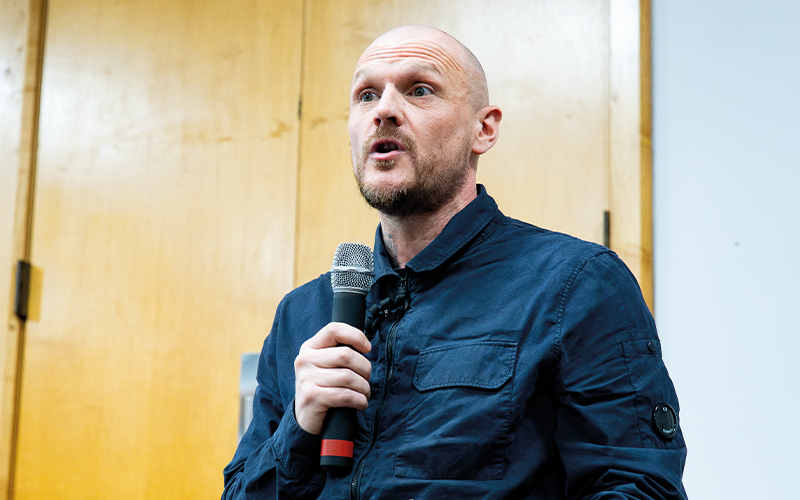
To say that Danny Wolstencroft’s life got off to the worst possible start, and carried on that way for 30 years, would be an understatement. Born to a teenage mum in care with drug and mental health problems, Danny was abandoned at 18 months before being placed in the custody of a family member who sexually abused him.
Unsurprisingly, the effect of such a childhood revealed itself in Danny’s behaviour at an early age. ‘I was the kid throwing chairs at teachers,’ says Danny. ‘I was the kid that the others would get to do naughty things. I’d been to nine different primary schools before I’d even reached secondary school. I’d worked out that nobody was coming to rescue me and everyone thought I was bad.’
At secondary school, the headmaster even told Danny he expected him to be dead or in jail by the time he reached 18. ‘The headmaster got a policeman to come in and speak to us. The copper showed us videos about car crime – I thought it was great and wanted to become a car thief. He also brought in a drug box and gave me an information booklet about all the different drugs – I thought it was a brochure. It all had the opposite effect on me than planned.’
‘NOBODY SAT ME DOWN AND ASKED ME WHY I BEHAVED THE WAY I DID. NOBODY ASKED WHAT WAS WRONG WITH ME’
MIRACLE MAN
From his mid-teens to early 20s, Danny became involved with drug dealing (he was groomed by a drug dealer) and went to jail on drugs-related offences. Life went on to progressively deteriorate in a continual cycle of poor choices, until a miracle of sorts happened.
‘When I was 30, I got sent to a drug worker. There was something nice and kind about him. He was one of the first people who treated me like a human being, and I started to open up to him,’ reveals Danny.
‘I had this mad suicide plan. I went to see this guy in November and gave myself until Christmas Eve to sort myself out. If I wasn’t able to sort myself out by then, I was going to kill myself.’
Unfortunately, even miracles don’t always work immediately. Danny came dangerously close to carrying out his plan following a disastrous visit to a doctor to get help. ‘I told the doctor about my suicide plan, but he didn’t even look at me; he just tapped away on his computer.’So Danny went straight from the doctor to the top floor of some nearby high-rise flats, only to turn back at the last second.
Danny explains: ‘I went to see the drug worker the next day. I was going mad, having a breakdown. The guy said to me: “What’s wrong with you Daniel? Come in and have a brew.” So I sat down and hesaid: “Let me tell you something. Do you think I was born like this? When I was little, something bad happened to me andit affected my entire life.”
‘The minute he said that, and the way he used self-disclosure as a tool, that allowed me to breathe a huge sigh of relief. He knew from his own experience and the way I was acting that I had been abused. So he started asking me about how things were as I was growing up.
‘By doing that, he put his foot in the revolving door of prison, probation, rehab, detox, mental health services, drug services. He yanked me out by my hood. He gave me permission to speak. That guy saved my life. But I was 30 years old – why had it taken from being 18 months old until I was 30 for somebody to give me permission to speak?’
LIVED EXPERIENCE MATTERS
Meeting the drug worker not only pulled Danny out of his cycle of personal self-destruction, but it also gave him a focus and a determination to use his life story and burgeoning interest in trauma treatment to set up his own community interest company. Around 2021, Danny co-founded Lads Like Us, to train others who might come into contact with people carrying the weight of trauma.
‘I made a promise that the gift that drug worker gave me, I will give to other people. Right now, I stand at having trained 98,000 people in the UK, and I’ll be at 100,000 by the end of 2025,’ he says.
‘What I try to teach is that people’s behaviour says a thousand words, even if they aren’t able to literally say exactly what they are thinking. I invented a training programme called A Million Pieces. It’s called that because we want to get the message across that somebody won’t break into a million pieces if you just ask them about what has happened to them. From what I experienced and what I’ve seen, there is a big misconception among some professionals that people with trauma are fragile. But asking questions doesn’t open a can of worms – it opens a door to healing.
‘The ethos around everything I do is based on trauma-informed practice and professional curiosity. But the difference with my training is the fact it comes from a lived-experience perspective. People don’t want death from a thousand PowerPoint slides, because everyone falls asleep. I come in wearing my shorts and sliders – I don’t care where I am – and I am authentic, I’m genuine; I swear, I am myself, and if anyone is offended, tough.’
CPs: THE FIRST LINE OF DEFENCE
‘School nurses [SNs] and health visitors are the most underrated,but most influential, group of professionals that I have come across,’ says Danny.
‘People think SNs are only there for nits in kids’ hair, but, actually, they can engage with social services for you, they can be the backbone for you, they can do everything you need. But people don’t know that.
‘The same for HVs. People think HVs are just there to tell you off when doing the wrong thing with your new baby, but a HV can transform your life. Talk about an early intervention; how early do you want? Birth!
‘If somebody discloses to a HV that they have experienced trauma, that HV can make sure they are supported so that generational trauma isn’t passed on. How good is that!’
HUMANITY IS KEY
‘Schools were asking me to come in to speak to pastoral staff,’ says Danny. ‘I said: “Why do you want me to only speak to pastoral staff? I need to be speaking to all teachers, I want the board of governors there, the caretaker, the lollipop man.” The NHS is brilliant at this – I get the guy who cuts the grass and the guy who puts notices on the noticeboard coming to my training. Those are the staff that people open up to because they’re seen as non-threatening.’
The range of people Danny now works with includes some from the systems that he felt let him down as a youngster – such as social services and the police – as well as the NHS, prison service, care homes, and organisations such as the NSPCC and Barnardo’s.
‘It’s not just about listening to people; you have to hear them,’ says Danny. ‘And you don’t try to understand what somebody says – you have to try to feel it. When you feel what somebody says, it sticks with you. None of this is rocket science; I’m just teaching people to be human beings and reminding them, whatever they do, not to forget to take the human being to work with them.’
Danny’s work has been recognised with an NHS safeguarding award. But he reveals that a greater highlight is when people come up to connect and disclose to him after a training session: ‘That’s a major moment. The amount of disclosures I get from professionals is unbelievable.’And there’s more. Danny says: ‘The amount of CEOs and company directors who come to me after I’ve given them training, who say they’re just like me but they’ve thrown themselves into their work. And now they’re at the top of the tree with nowhere else to go, and now they’re panicking about what to do when their job finishes. They don’t feel they can tell anybody at work, because they’ll be judged, but they can tell me.
‘WE WANT TO GET THE MESSAGE ACROSS THAT SOMEBODY WON’T BREAK INTO A MILLION PIECES IF YOU ASK THEM WHAT HAS HAPPENED TO THEM… IT OPENS A DOOR TO HEALING’
THE MISSION
‘What’s mega important for people to know is that trauma is relative to the individual. Even though what two people have been through might be different, and it might seem different levels of seriousness, the way they both react to it might be the same. There might be kids who are throwing their energy from their reaction to trauma into their academic work, in the same way that I threw mine into crime. They might be self-harming in quiet, or have eating disorders in quiet.
‘This is why I am on this mission. Nobody sat me down and asked me why I behaved the way I did. Nobody asked what was wrong with me. Nobody asked. I know I put a mask on and people thought I was OK – but was I so good at masking the troubles that everybody I came into contact with thought things were fine? I don’t think so, I think some people just couldn’t be bothered. That needs to change.’
With Danny at the helm, change feels possible. The VoiceAbility charity has recently asked Danny to be involved with a roadshow, which will be taking place at 14 locations up and down the UK in the coming months. Danny says: ‘Wherever we go, we’ll have local councils and local professionals coming along. I’ll be hitting each town, passing on my message.’
ALL ABOUT DANNY
Family life Danny and his wife, Kyta, live in Manchester, with their son, who recently started secondary school.
Best advice received Vulnerability can be your greatest strength – it’s the sharpest tool in my box when I give training.
Surprising fact I’m still alive! I should have been dead about 10 times over.
How do you relax? I don’t. I’m like a washing machine on spin cycle. If I’m not doing something productive, I fall to pieces.
Favourite place to be There’s a place called Pots and Pans in Oldham. You walk up a hill and you’re on top of the moors. I go up there and walk for miles.
Image | Unite-CPHVA