

Aisling Swaine, Professor of Peace, Security and International Law at University College Dublin, talks about the subtle forms of coercive control CPs may be able pick up on, and why your help is so vital.
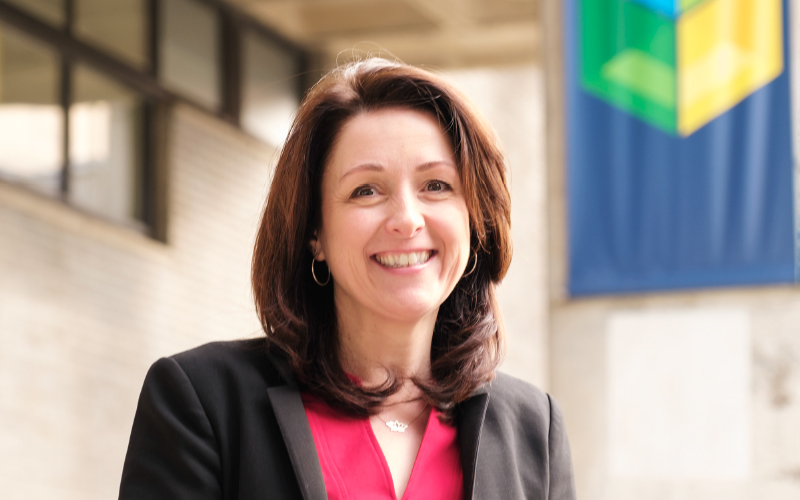
Coercive control charges are rising in England and Wales, but successful prosecutions are still low – often because of the difficulties of proving abuse, particularly where there are no physical signs. If there’s anyone who can offer advice about the complexities of coercive control and what’s needed to improve outcomes for women, it’s Professor Aisling Swaine.
‘Right now, research and the law give recognition to coercive control which has been a fantastic shift in how we understand violence against women,’ explains Professor Swaine. ‘While there is important recognition that coercive control may involve physical assault, research is also showing that often the criminal justice system over-relies on the physical aspects, so it becomes about the physical harm, bruises and evidence of non-fatal strangulation, fear, and soon. But it’s also much more than that; it’s about being told what you can and can’t wear, being forced to leave your job, having every move watched, being isolated from family and friends, and not being allowed to access services, such as medical appointments.
‘I think we need to understand that the panoply of what makes up coercive control is much broader and involves things that are harder to see, invisible threats, intimidations and resulting sentiments and feelings. I think the more we make those visible and make them count, the more our legal system and policing system will have to take them seriously.’
Global perspective
Although Professor Swaine’s PhD is in international law, she is not a lawyer by background. ‘I started out doing humanitarian emergency work, with international organisations delivering services in armed conflicts around the world in places like Darfur, Sudan.
‘I spent just over seven years doing frontline service delivery, always on women’s rights and gender equality. During that time, I slowly moved into the violence against women field as that became more recognised as part of armed conflicts, and ended up delivering services
to women who’ve either experienced mass rape and sexual violence in war, or domestic violence and broader forms of
gendered harm.’
Later Professor Swaine went on to gain experience in policy and worked for the Irish Department of Foreign Affairs and Trade, did a PhD at Ulster University in Belfast and moved to the US to work for the United Nations in New York on international peace and security.
Then followed a career in academia, at George Washington University in Washington DC, the London School of Economics, and now at University College Dublin.
WHAT IS COERCIVE CONTROL?
- Coercive control is an offence under Section 76 of the Serious Crime Act 2015 in the UK, in the context of an intimate or family relationship.
- Relevant behaviour can include isolating a person from their friends and family, love bombing and gaslighting, depriving them of their basic needs, monitoring their time, monitoring their activity via online communication tools, or using spyware (CPS, 2025).
- The Crown Prosecution list is extensive and even then, not exhaustive.
- The Office for National Statistics (ONS) reported that police recorded 49,557 offences of coercive control in the year ending March 2025 in England and Wales.
- There were 1299 that reached court and 853 offenders successfully convicted in 2024 (Women’s Aid, 2025).
The Northern Ireland context
Professor Swaine will be speaking at the Unite-CPHVA conference in November about her research published earlier this year (Swaine, 2026). It was conducted with the Foyle Family Justice Centre in Northern Ireland and is about coercion experienced by women who are in
relationships with men involved in paramilitarism in Northern Ireland.
‘In many conflict-affected settings globally, there have been mass forms of physical and sexual violence against women, which have thankfully become recognised,’ says Professor Swaine.
‘But I have always noticed there are other forms of harm that you can’t quite see, or don’t quite look like that, and they never get attention.
‘In Northern Ireland, an independent commission and women’s organisations have been saying that paramilitary groups are coercively controlling communities, and women were caught up in this.’
Professor Swaine came in on the back of work that communities, scholars and organisations had already done to consider ‘Well what does that look like today?’. She has interviewed women who described what it’s like to be in a relationship with a man who is a member, or pretends to be a member, of a paramilitary-type group located in their communities.
‘In some sense, the groups are not present in the way they used to be during the Troubles, but they still very much have influence, and a kind of social control and gatekeeping power – like a gang,’ explains Professor Swaine.
‘I’ll be talking at the conference about what that feels like for women, and if we call it coercive control, what do we mean by that? Because we still have an idea that coercive control is a pattern of behaviour between two people. It can be. But for me, I’m thinking about what that means if he [the man] has a background in which he can draw from more powerful resources that create fear for her.’
‘If a practitioner goes in and senses an atmosphere, then that atmosphere matters – write it down. What was contributing to it? Is she comfortable in her own space?
INCREASING VISIBILITY
‘There’s research in the UK and elsewhere that uses coercive control as a framework for describing how women experience gangs that are present in communities, or familial practices of forced marriage, for example. So, what I really am trying to get at right now is that if a woman is in a relationship with someone, but there is a broader network or a broader context that empowers the control he has, how do we
make that visible and make sure we address that broader context in our services also?’
Professor Swaine says that often women are not believed, with research showing that criminal justice systems may still rely on descriptions of physical violence or attack or strangulation. But, she says, often coercive control can emerge from a knowingness between a man and a woman that comes from the context of their relationship; a ‘loaded look’ can be enough.
‘When a police officer or a health worker or someone comes in, and she tries to describe it, it doesn’t reach the threshold of criminality of the law, but it still is enough to coerce her. ‘So, I’m trying to make that invisible bit visible and matter for how we understand what harm is for women.’ How can CPs detect the subtle signs of coercive control? ‘I would say it’s about picking up on all the things that are not
taken seriously. Those hunches that are instinctual, that voice in your head that tells you there’s something going on here,
but you can’t quite put your finger on it,’ says Professor Swaine.
‘There’s recognition of patterns and behaviours and dynamics in criminal law now, which is fantastic. But there’s also acknowledgement that there are these other things that make up part of the harm. In my research I’m interested in what women say amounts to harm rather
than trying to describe something so it fits with the legal definition.’
Professor Swaine says the way a question is asked can open up a space for a woman to say something or equally it can
shut it right down. ‘For example, if you ask someone “Are you experiencing domestic violence or coercive control?” you’re already
foreclosing something. I have had women say things to me like, “Well, what I experienced wasn’t like so and so”, and so
they’re already placing their experience into a hierarchy of what matters. In my research I’m trying to get rid of the hierarchy, and say, how can I make visible what’s there?’
ALL ABOUT AISLING
I’m a solo parent to my eight-year-old daughter and work full time. I moved back to Ireland to raise her here and to be near extended family after 27 years working all over the world in global conflicts, global policy and academia. I live about half an hour from where I grew up, which is kind of funny given how I went very far away. I have five siblings, and there are 12 grandchildren, so we’re a very large family, which is lovely and it’s just brilliant to be back home at this stage of my life.
Yoga has been a huge part of my life. I encountered it first when I lived in Asia, and it has been the tool that has helped me cope with a lot of the things that I have witnessed and lived in and through. What is great is that a yoga mat can be carried anywhere, whether it’s on my back on a helicopter in Darfur or elsewhere.
My house is the floweriest possible. For years I lived in compounds and insecure places, and I was desperate for a garden and to grow herbs and flowers. Now I have a house with a garden, and you’ll find me out there every evening. It’s a gift.
I’m 50 and I love being this age. To have lived independently around the world and now to be able, at this stage of my life, to have my daughter and set up a home and life in Ireland, it’s great. My daughter and I frequentlyhave Saturday night discos in our kitchen!
When I’m stressed, I turn to poetry. Carolyn Forché is a favourite, I love her because she has written about the experience of living and working in conflicts. And Mary Oliver’s Wild Geese – finding your place ‘in the family of things’ has been a guide.
FRONTLINE HEROES
Professor Swaine explains how CPs can have such a vital role to play. ‘If a practitioner goes in and senses an atmosphere, then that atmosphere matters – write it down. What was contributing to it? How is she holding her body? Where is she sitting? Where is she not sitting? Is she comfortable in her own space? Does she look like she owns it? Are there habits and patterns that you see her doing every
time you meet her? What are the habits – are they at a certain time, or are they in a certain space? Is it a certain way of talking
if he’s there, or if he’s not there?
‘When I have interviewed women with very deep experiences of domestic abuse and coercive control or conflict-related violence, it has been that one police officer or that one health worker who stuck with them and provided the right question or the right piece of information at the right time and worked with her wider family, that helped her,’ she explains.
‘I think those people who are the front-line contacts are absolute lifelines for these women. I talk to service workers who go into homes and communities that are not the safest for them to go into, and they’re incredibly brave. They go in there and they witness things and they leave again and they find a way to provide support to women. Keep on doing what you are doing.’
Professor Aisling Swaine is a Keynote speaker at the Unite-CPHVA Annual Professional Conference. Her session: Making visible wider structures and networks of coercion in women’s experiences of coercive control is on day two, 5 November 2026
REFERENCES
Swaine A. (2026) Conflict-Related Coercive Control: A Framework for Understanding Women’s Experiences of Group-Based Coercive Control in Conflict-Affected Settings. See: https://journals.sagepub.com/doi/10.1177/10778012251409155?int.sj-full-text.similar-articles.3 (accessed 2 September 2026).
Home Office. (2015) Serious Crime Act 2015. See: https://www.legislation.gov.uk/ukpga/2015/9/section/76/2015-12-29 (accessed 2 September 2026).
Crown Prosecution Service. (2025) Controlling or Coercive Behaviour in an Intimate or Family Relationship. See: https://www.cps.gov.uk/prosecution-guidance/controlling-or-coercive-behaviour-intimate-or-family-relationship (accessed 2 September 2026).
Office of National Statistics. (2025). Domestic abuse prevalence and trends, England and Wales: year ending March 2025. See: https://www.ons.gov.uk/peoplepopulationandcommunity/crimeandjustice/articles/domesticabuseprevalenceandtrendsenglandandwales/yearendingmarch2025 (accessed 2 September 2026).
Women’s Aid. (2025) What is coercive control? See: https://womensaid.org.uk/information-support/what-is-domestic-abuse/coercive-control/ (accessed 2 September 2026).